
A straightforward online probate application in England and Wales took less than one week to receive a court grant in late 2024, according to a UK Ministry of Justice announcement, with about 80% of applications now submitted digitally. The slow tail of that same system looks very different: 90% of applications completed in early 2025 finished within roughly 126 days, which means the hardest cases took months for the exact same piece of paper. Two numbers, one process, and the distance between them is where families get confused.
In the United States, court-supervised probate is commonly benchmarked in months or years rather than weeks, though no single national average exists because every state and county court sets its own rules, staffing levels, and hearing schedules. What holds true almost everywhere is that the executor's legal authority arrives long before the estate is finished.
That gap catches families off guard. The grant works like a license: it gives the executor permission to act, but it says nothing about how long the work itself will take. Answering how long does probate take only helps when the court grant is separated from full estate settlement. In most estates, operational work outside the courtroom sets the total wait. Locating missing accounts, resolving real estate title defects, waiting out creditor windows, and clearing taxes all move on their own clocks, and none of them speed up just because a judge has signed an order. The court queue matters, but it is rarely the longest line a family stands in.
Table of Contents
- Typical Probate Timelines at a Glance
- How Timelines Differ by Place
- How Probate Moves Through Each Stage
- Factors That Set the Pace of Your Estate
- Common Causes of Delay in Probate
- Why Court Approval Is Not the Finish Line
- Ways to Shorten Probate Without Cutting Corners
- Decide Whether to Hire Help or Handle It Yourself
Typical Probate Timelines at a Glance
A useful probate timeline has two clocks. One clock measures when a court gives the personal representative authority to act. The other measures when the estate is settled, with debts handled, taxes cleared, assets collected, and distributions made. Families often focus on the first clock because it feels official. The second clock usually determines how long the matter stays open.
An ordinary court-supervised probate case in the United States is commonly benchmarked at roughly 9 to 24 months, though that range isn't a guaranteed national average or statutory deadline because state and county courts set their own rules, as explained by the Alameda County Superior Court. Think of the benchmark as a map with a wide scale. It helps you see the terrain, but it cannot tell you how long every errand will take.
California's court guidance shows the same pattern. Under the Lassen County Superior Court probate overview, a standard California court-supervised case generally takes 9 to 18 months. That period covers the court-supervised path from petition through administration, not just the date of the first hearing. Within that window, tasks overlap. Notices may go out while assets are being located. Appraisals may proceed while creditor claims are pending. A real estate sale may wait for clear title, even when the rest of the estate is ready to move.
Creditor rules create the firmest legal floor underneath those dates. Under California Probate Code Section 9100, a creditor generally must file a claim by the later of four months after letters first issue to a general personal representative or 60 days after the creditor receives required notice. Until that window closes and valid liabilities are evaluated, an estate can't safely finalize its accounting and distribute remaining assets. This is one reason a case can look quiet for a while. The legal clock is still running.
Probate Timeline by Stage
| Stage | Typical duration | What sets the pace |
|---|---|---|
| Petition filed and executor appointed | Weeks to months, depending on the court | Court calendar, filing completeness, and whether the will is contested |
| Creditor claim window | Later of four months after letters or 60 days after notice, under California law | Timing of creditor notices and state statutes |
| Inventory and appraisal | Several months in many estates | Number of assets, records, and real estate appraisals |
| Federal estate tax return | Due when required under federal rules | Whether the estate meets federal filing requirements |
| Final accounting and distribution | Often late in the court-supervised case | Disputes, property sales, creditor resolution, and tax clearance |
| Overall court-supervised probate | Roughly 9 to 24 months in the United States, 9 to 18 months in California | Jurisdiction, complexity, and disputes |
The table is a way to separate visible court events from the work that happens around them. A hearing date may be set by a calendar. An estate bank account, a missing beneficiary, a lien, or a property sale follows a different rhythm. That difference explains why two similarly sized estates can close months apart.
Alameda County Superior Court guidance also notes that a personal representative generally must complete probate within one year of appointment unless a federal estate-tax return is filed, while cautioning that some estates still take years. Before estimating a closing date, look up the local probate court's published calendar and identify which stage the estate currently sits in.
How Timelines Differ by Place
Published probate timelines shift dramatically across borders and even between neighboring counties, because every court system measures different milestones under different statutes. In the United States, probate is run at the state and county level, so docket congestion, local filing rules, and mandatory supervision vary widely from one courthouse to the next. Two estates holding identical assets can finish months apart purely because of where the deceased lived.
England and Wales offer a clear illustration of how court-processing speed can change over time and why reading the fine print on any published statistic matters. A UK Ministry of Justice evaluation report found that average probate-application length rose from 67 days for cases received in the third quarter of 2019 to 104 days in the third quarter of 2023, before dropping to 22 days for applications submitted in the first quarter of 2025. That same evaluation reported that approximately 70% of applications were filed within 180 days, or about six months, of the person's death.
That swing deserves attention. A system that took over three months per application in 2023 was processing them in about three weeks less than two years later, which means any timeline quoted without a date attached may already be obsolete.
What Quarterly UK Grant Figures Show
Recent quarterly snapshots show how steadily processing improved once digital filing took hold, while also revealing how much filing method affects the wait:
- Mid-2024 baseline: In June 2024, average probate-grant processing took 8.5 weeks after receipt of required documents, according to a UK Parliament written answer.
- Digital versus paper gap: For December 2024 cases, Legal Futures reported HMCTS figures showing digital submissions averaged 4.8 weeks, compared with 14.6 weeks for paper applications. The same courthouse, the same law, and the same estate can produce waits three times apart depending on how the paperwork is filed.
- Long-tail delays and cross-border rules: Even with faster averages, a Judge Law review of UK probate timelines reports that 9,480 probate cases took more than six months in 2024/25, and 2,040 took more than a year, driven by issues such as missing documents and hard-to-locate executors. For international estates, that review notes that EU guidance generally assigns succession to a court or notary in the country where the deceased last lived, while assets in other countries can require separate local proceedings.
Read those two patterns together and a practical lesson emerges. Averages describe the clean, well-prepared cases. The tail belongs to estates with missing paperwork, executors who cannot be reached, or property scattered across jurisdictions, and those operational problems matter far more than how fast the court itself moves.
England and Wales statistics measure the wait for a grant of probate, not the months spent selling property, paying debts, and transferring inheritances. Comparing a grant-only timeline directly against a full US court-supervised probate schedule mistakes the opening whistle for the end of the game.
That distinction is the single most common source of confusion when families compare timelines across countries. The grant is permission to start the work. Settling the estate, which means collecting accounts, selling or transferring real estate, paying creditors, and distributing what remains, continues for months afterward in almost every jurisdiction, and that work rarely appears in any court's published processing figures.
How Probate Moves Through Each Stage
Probate isn't a single waiting room. It's a sequence of formal legal checkpoints built to verify a will, give creditors a fair window to step forward, and prove to a judge that every asset went to the right person. Understanding what happens at each step makes the calendar far easier to read.
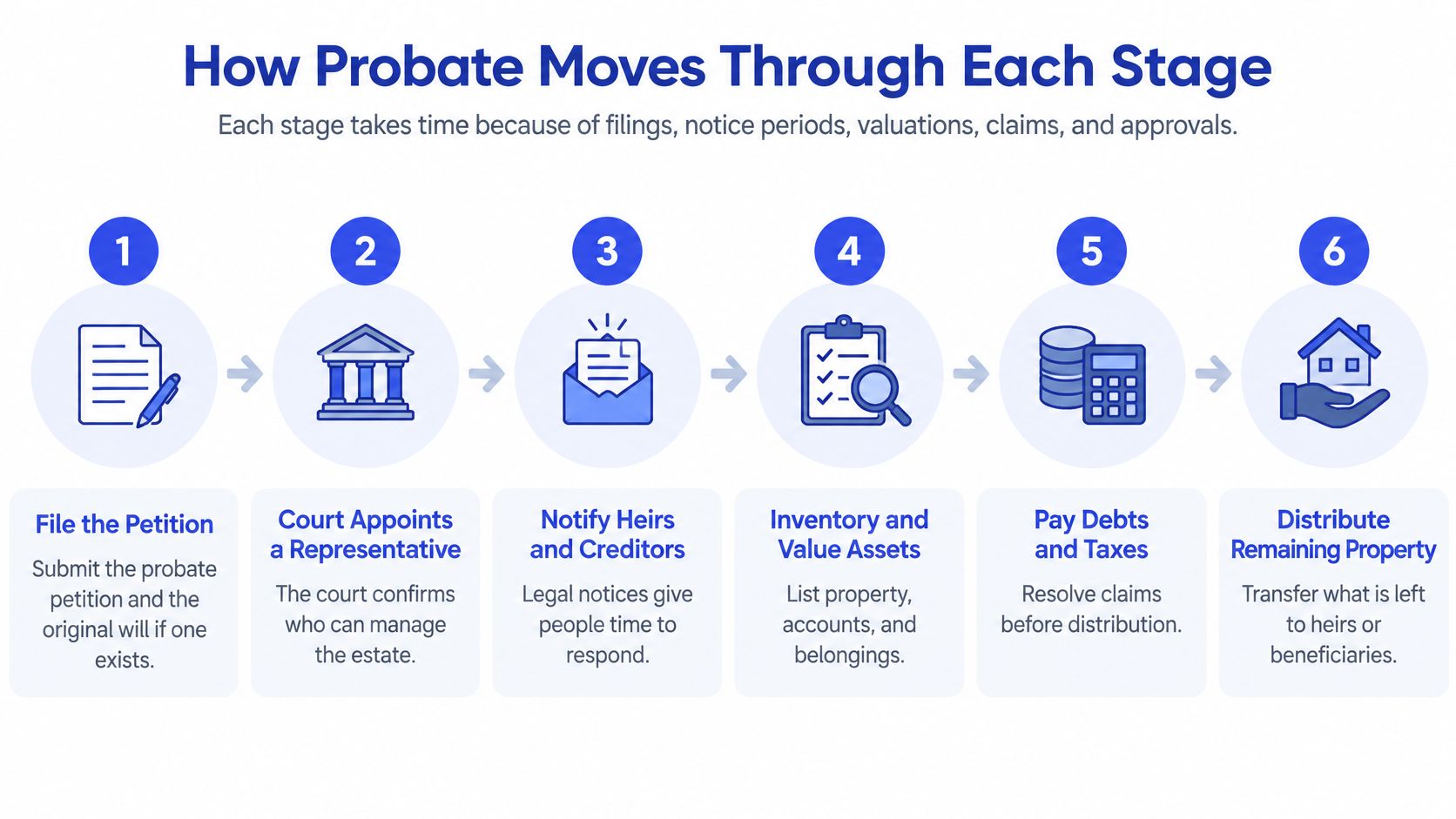
The visual overview below maps the core progression from initial petition to final asset transfer.
The Seven Operational Stages From Filing to Closure
- File the petition with the probate court. The person seeking appointment submits the probate petition, a certified death certificate, and the original will if one exists. Waiting for clerk intake and an open hearing slot takes weeks in most counties, and missing original documents or unsigned pages trigger immediate rejections.
- Secure appointment and letters of authority. At the initial hearing, the judge formally appoints the executor (if named in a will) or administrator (if there is no will) and issues certified Letters Testamentary or Letters of Administration. Banks, title companies, and brokerages won't release information or funds without those letters, though objections from relatives or a required fiduciary bond can stall their issuance.
- Notify heirs and known creditors. Once appointed, the personal representative mails formal notices to beneficiaries and known creditors and publishes legal notice in a local newspaper if state law requires it. That step starts the statutory creditor-claim clock, and every week spent tracking down old mailing addresses pushes back the earliest safe distribution date.
- Identify, inventory, and appraise estate assets. The representative compiles a complete list of bank accounts, investment portfolios, retirement plans, vehicles, real estate, and valuable personal property, then secures date-of-death valuations from licensed or court-appointed appraisers. Scattered paperwork, hidden safe-deposit boxes, and specialized appraisals for real property or collectibles are the most frequent holdups here.
- Pay valid debts, administrative costs, and taxes. Using estate funds, the representative reviews incoming claims, disputes inaccurate bills, keeps mortgage and property insurance payments current, and works with a CPA to file the decedent's final personal income tax return alongside any required estate income or estate tax returns. Preserving enough cash liquidity to cover uncertain tax bills or disputed medical claims often keeps accounts open far longer than families expect.
- File the final accounting and distribution petition. Once debts and taxes are settled, the representative submits a detailed financial report showing every dollar received, paid out, and remaining, along with a proposed distribution plan. Court examiners audit those numbers before the judge signs an order, so missing receipts or math errors routinely trigger continuances.
- Distribute remaining assets and obtain a closing order. After judicial approval, the representative transfers deeds, retitles vehicles, sends inheritance checks or wires, collects signed beneficiary receipts, and files for a final discharge order. Slow title recordings or beneficiaries who fail to return signed receipts can keep an otherwise finished estate open for extra weeks.
Overlapping Tasks to Save Months
Faster estates don't bypass legal safeguards; they run compatible tasks at the same time. The week certified letters arrive, an organized personal representative can mail creditor notices, order real estate appraisals, open an estate checking account, and send verification letters to financial institutions simultaneously. Waiting for the creditor claim window to close before starting asset valuations or preparing a house for sale easily adds months that didn't need to be spent.
Factors That Set the Pace of Your Estate
Structural features of an estate establish its baseline timeline long before a petition reaches the courthouse clerk. Operational snags then pile extra wait time on top of that foundation.
Before projecting a settlement window, attorneys typically review the deceased's documents and asset mix to spot complexity early.

The presence or absence of a valid will is usually the first major fork in the road. When someone dies intestate (without a will), the court must verify legal heirs under state succession statutes and confirm who has priority to serve as administrator before anyone can manage accounts, which routinely adds months before administration even hits its stride.
Account sprawl adds steady administrative drag even when a will is crystal clear. Every checking account, brokerage holding, life insurance policy, and retirement plan carries its own claim packet, medallion signature guarantee requirement, and internal compliance review, adding weeks to months as accounts multiply.
Real estate introduces a heavier operational layer. A single house often adds several months because it requires a formal appraisal, ongoing hazard insurance, possible cleanout or repairs, title clearance, and either a negotiated sale or court confirmation. If the deceased owned land or a vacation home in another state, the estate faces ancillary probate in that second jurisdiction, complete with separate court filings, local counsel, and its own hearing calendar.
People and specialized assets widen the range even further. Tracking down notarized consents from heirs scattered across states or living abroad adds weeks or months of mailing and authentication delays. Ownership in a closely held company or family LLC adds months for formal business valuation and review of buy-sell agreements, while contested creditor claims or tax authority disagreements can freeze final distribution for a year or more. Finally, county probate court workload directly dictates how long an estate waits between every routine hearing.
Estate Factors and Their Effect on Timing
| Factor | Effect on timeline | Example |
|---|---|---|
| Will versus no will | Intestacy usually adds time | Heirs must be located and a court must confirm them |
| Many accounts or policies | Adds weeks to months | A forgotten retirement account found after filing |
| Real estate | Often adds several months | House must be appraised, cleared of title issues, or sold |
| Out-of-state property | Requires ancillary probate | Vacation home in another state needs its own filing |
| Number and location of heirs | Adds time for signatures and notices | Heirs abroad must sign notarized consents |
| Creditor or tax disputes | Can add a year or more | A disputed claim is held until it is resolved |
| Business interests | Adds months for valuation | Ownership in a family LLC with a buy-sell agreement |
| County court workload | Adds weeks to months on busy dockets | Busy probate dockets slow hearings |
Count how many of those eight factors apply to the estate you're handling. An estate with an uncontested will, local heirs, and a handful of liquid bank accounts typically lands near the faster end of local timelines, whereas combining real estate, missing records, out-of-state property, or beneficiary friction pushes the schedule toward the slower end.
Common Causes of Delay in Probate
A true probate delay isn't the mandatory notice period written into state law. It's the preventable gap between when a milestone could reasonably wrap up and when it finishes.
Missing or incomplete paperwork causes more day-to-day slippage than almost any other issue. Probate clerks strictly enforce formatting, notice wording, and supporting attachments, so a single missing signature or incorrect legal description sends the filing back and resets the hearing calendar by weeks.
Common Causes of Probate Delay
| Delay cause | How it shows up | Typical added time |
|---|---|---|
| Missing or incomplete documents | Clerk rejects a filing | Several weeks per correction |
| Unlocated heirs or executor | Notices returned, signatures missing | Several months |
| Forgotten or unknown assets | Account found after the inventory is filed | Amended inventory and extra months |
| Contested will or beneficiary dispute | Objection filed and hearing set | Six months to over a year |
| Late or missing creditor notices | Claim window cannot close | At least the full claim period |
| Tax clearance wait | Distribution held until tax letter arrives | Several months |
| Unmaintained property | Insurance lapses or repairs are needed | Delayed sale and lower value |
Early Warning Signs Families Can Spot
Catching friction early prevents minor oversights from snowballing into multi-month setbacks:
- Repeated clerk deficiency notes: Getting more than one rejection notice or hearing continuance signals that filings aren't matching local court checklists.
- Returned mail and unanswered calls: Undeliverable certified envelopes or relatives who stop replying usually mean a signature bottleneck is forming months before final distribution.
- Unexpected tax documents in the mail: A surprise Form 1099, brokerage statement, or property tax bill arriving after the inventory is filed points to an overlooked asset that will require an amended court filing.
- Growing friction over personal items or recent will edits: Tense text threads accusing someone of unfair influence often foreshadow a formal objection that can stall the entire estate.
- Unopened creditor statements: Stacks of medical invoices or past-due utility notices suggest creditor notices weren't sent promptly, keeping the legal claims window propped open.
- Missing prior-year tax filings: When the executor can't locate the deceased's recent federal or state returns, reconstructing income history and waiting on tax clearance will hold up final checks.
- Deferred home upkeep: An expired homeowner's policy, overgrown yard, or leaking roof invites vandalism, insurance cancellation, and buyer financing failures that drag out a sale.
Delays You Control Versus Delays Others Control
Knowing where effort moves the needle keeps executors from burning out. Families can't force a probate judge to add hearings to a packed county calendar, rush a tax agency's review queue, or stop a determined litigant from filing motions.
Executors directly control document accuracy, prompt creditor notices, thorough asset discovery, active property maintenance, and clear communication with beneficiaries. Putting energy into those controllable tasks eliminates most avoidable resets.
Practical rule: You can't speed up a courthouse docket or a tax agency's processing desk, so protecting the timeline comes down to eliminating self-inflicted resets on paperwork, notices, and property care.
Why Court Approval Is Not the Finish Line
Families often feel a wave of relief when a judge signs the order appointing the executor, assuming the wait is over. In reality, court approval only hands the personal representative the keys to begin the heaviest phase of estate administration.
Seeing the moment a court grants authority in context helps clarify why so much work remains afterward.
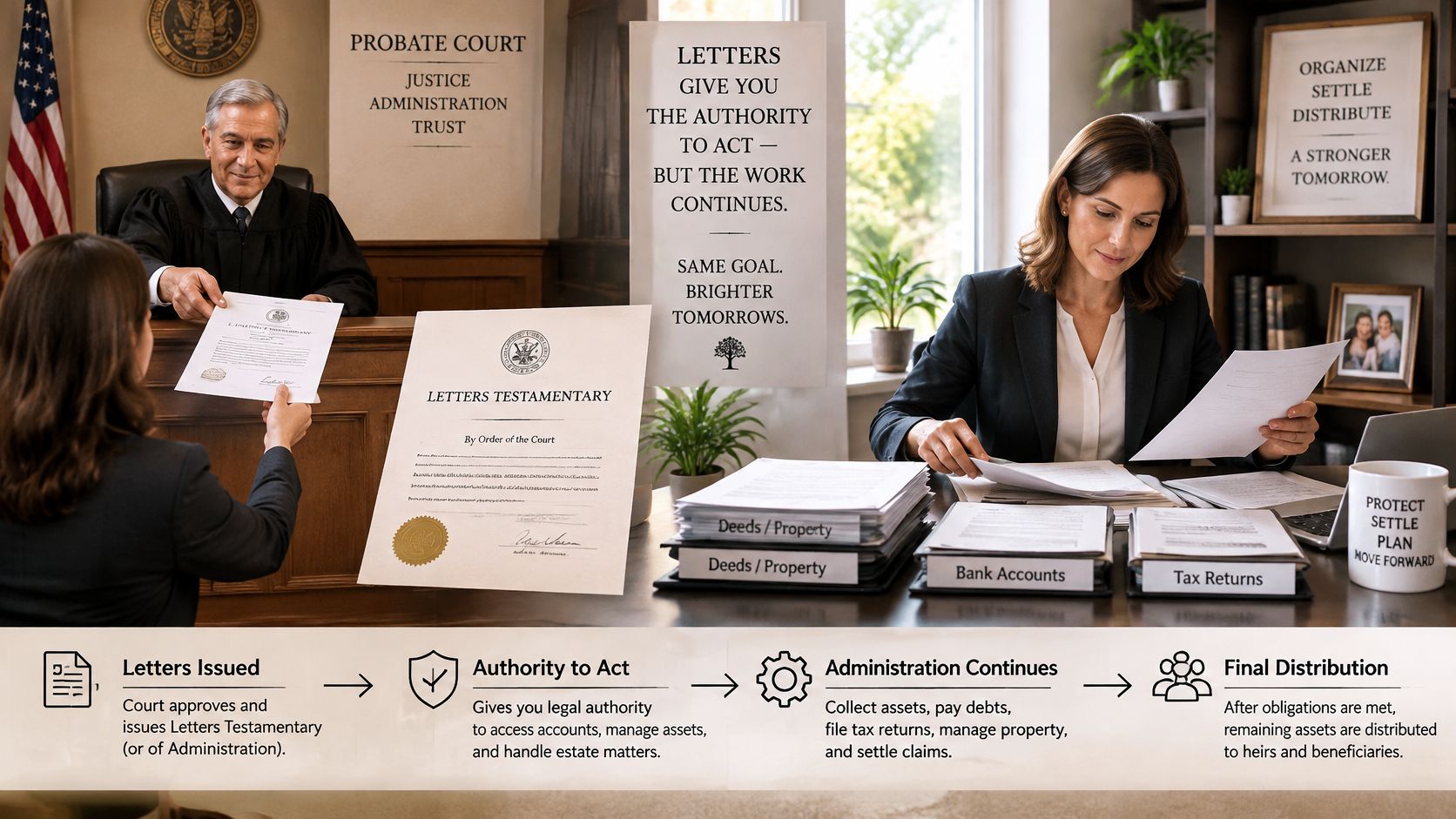
Consider a realistic scenario that plays out in probate courts every week. Say an executor files cleanly and receives certified letters in month two, allowing them to access bank accounts and prepare the family home for sale. During title review, the title company uncovers an unreleased mortgage lien from a refinance completed decades ago, forcing legal tracking and clearance that holds up closing until month nine. After the home finally sells, the CPA prepares the estate's fiduciary income tax return and waits for written tax confirmation before advising final distribution, pushing beneficiary checks to month fourteen.
Four Milestones to Track Separately
Treating probate as one monolithic clock breeds frustration. Tracking four distinct milestones gives families an accurate picture of progress:
- Court authority: The date the court issues certified letters authorizing the representative to act on the estate's behalf.
- Asset discovery: Confirming that every bank account, investment, policy, vehicle, and personal asset has been identified, documented, and valued.
- Property resolution: Securing inherited real estate, resolving title defects or repairs, and completing either a sale or a formal deed transfer.
- Final distribution: Paying approved debts, receiving court sign-off on the final accounting, and delivering inheritances to beneficiaries.
The walkthrough video below breaks down how probate timelines unfold in practice and why post-appointment administration often drives the bulk of the wait.
Even after a probate judge signs the closing order, practical loose ends can linger. The personal representative may still need to file a final individual income tax return for the year of death, close residual estate bank accounts once every distribution check clears, or petition to reopen the estate if an unclaimed account or mineral right turns up later. Speeding up the initial court order rarely shortens the total wait unless property, asset, and tax work run alongside it.
Ways to Shorten Probate Without Cutting Corners
Mandatory notice periods and judicial calendars can't be skipped, yet methodical preparation before filing and disciplined execution afterward regularly trim months of preventable friction.
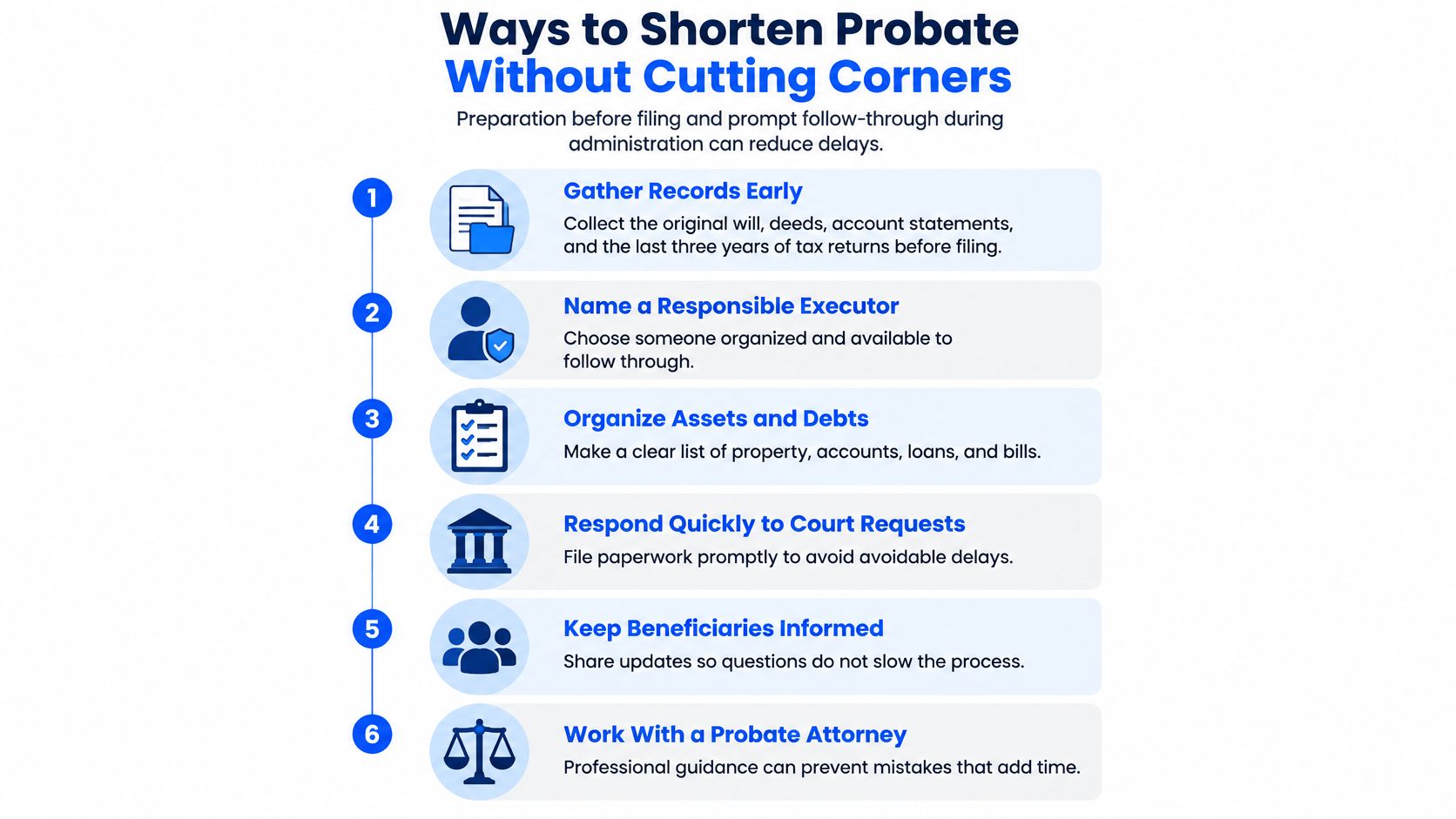
The checklist below highlights six core habits that keep probate moving cleanly without exposing the executor to legal trouble.
Eight Practical Actions During Administration
- Gather core records before filing the petition. Pulling together the original will, real estate deeds, recent account statements, and the last three years of tax returns before approaching the court saves weeks of clerk rejections and prevents months of later guesswork.
- Maintain one master asset-and-debt spreadsheet. Logging every account number, balance, recurring bill, and claim inside a single spreadsheet (using Excel or Google Sheets) saves weeks when preparing the final accounting and reduces the risk of filing an amended inventory.
- Send creditor notices immediately after letters issue. Mailing required notices right away starts the statutory claims clock weeks sooner, whereas skipping or delaying notice exposes the executor to personal liability and can force an expensive estate reopening.
- Order real estate appraisals early and maintain the property. Booking a licensed appraiser promptly and keeping vacant-home insurance, utilities, and basic repairs current prevents months of buyer-financing delays and avoids steep discounts or uninsured storm damage.
- Work through a structured account-category checklist. Checking bank accounts, brokerages, retirement plans, life insurance policies, vehicle titles, and digital accounts in one sweep prevents a late-discovered asset from adding months right before closing.
- Confirm heir contact details early. Reaching out to every beneficiary right after appointment to verify current addresses and explain upcoming paperwork shaves weeks off signature collection and lowers the odds of suspicious delays.
- Ask the court clerk about local filing requirements. Reviewing the county's probate checklist or asking the clerk what triggers the most rejections prevents multi-week continuances over minor formatting mistakes.
- Request partial distributions only when clearly permitted. Releasing partial funds early can help waiting heirs when state law, the judge, and conservative cash reserves allow it, though distributing money before debts and taxes are certain puts the executor's own assets at risk.
Liability check: Cutting corners on creditor notices or premature payouts doesn't shorten probate. It shifts unpaid debts and legal penalties straight onto the personal representative.
Planning Ahead With Non-Probate Transfers
Families planning ahead before a loss can move many assets outside probate entirely using joint ownership with rights of survivorship, payable-on-death (POD) or transfer-on-death (TOD) beneficiary designations, and properly funded revocable living trusts. Those tools only work when set up and funded before death, and each carries distinct legal, tax, and administrative trade-offs that warrant review with an estate planning attorney.
Decide Whether to Hire Help or Handle It Yourself
Executors aren't stuck choosing between doing every filing alone and surrendering control of a loved one's legacy. The right level of help depends on the estate's structure, where the family lives, and how much time the personal representative can dedicate alongside work and family life.
Matching Support to Your Estate
- Handle it yourself: Self-administration can be realistic when the estate is modest, the will is uncontested, every asset sits in one state, financial paperwork is neatly organized, and the executor lives nearby with steady weekly availability.
- Hire a licensed probate attorney: Legal representation is essential whenever an estate involves a contested will, real estate in multiple states, disputed creditor claims, business ownership, or complex estate and fiduciary tax filings.
- Bring in full estate settlement support: End-to-end coordination makes sense when heirs live out of the area, financial records are scattered or missing, an inherited home needs cleanout, maintenance, or title resolution, or the executor can't take on months of daily logistics.
For families facing that heavy administrative burden, Semper Terra helps heirs, executors, and families who aren't looking to spend upwards of 500+ hours on the legal and financial rabbit hole of estate resolution. Each family is paired with a single point of contact who handles day-to-day coordination across asset discovery, real estate resolution, creditor management, and vetted legal or tax professionals, while the executor retains full decision-making authority throughout the process.
Start by checking the probate court calendar in the county where the deceased lived, confirming which stage the estate currently sits in, and booking a consultation with a licensed probate attorney if any complicating factor applies. Clear expectations about both the court steps and the outside operational work give families a steady roadmap from the first filing to final closure.
If an estate involves scattered records, inherited real estate, out-of-area heirs, or mounting creditor correspondence, hands-on coordination can keep operational work moving alongside the court calendar. Semper Terra pairs families with a single dedicated point of contact to manage asset discovery, property resolution, and estate logistics while the executor stays in control of every decision. Visit Semper Terra to explore how structured estate settlement support can take the administrative load off your family.
This article is for information only and is not legal advice. Semper Terra is not a law firm.